
Power Shift - Introducing a collaborative investigation into the impact of Scotland’s green energy boom
Scotland’s green energy revolution is reshaping who holds the power. From island wind farms to grassroots energy ownership, The Power Shift is a bold new collaborative investigation looking into how communities across the country are navigating the promise, pitfalls, and politics of renewables.
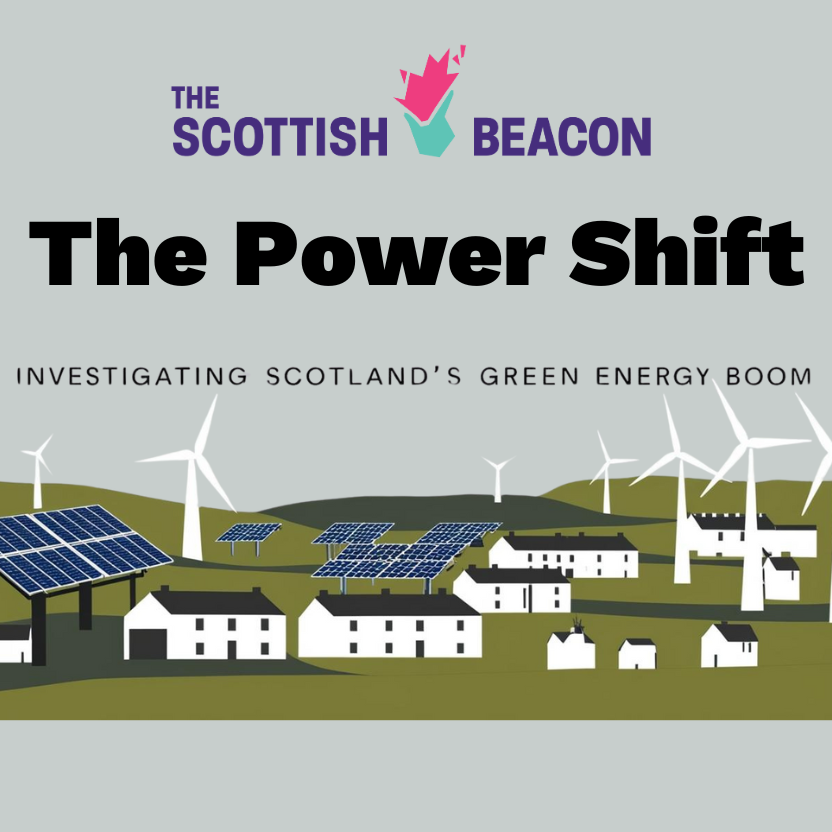
This project is an innovative collaboration between ten independently owned, community-based newspapers and magazines examining how Scotland’s green energy transition is reshaping land, communities, and power dynamics across the country.
The ten partners Shetland News, Kyle Chronicle, Bylines Scotland, Glenkens Gazette, Forres Local, Am Paipear, The Bellman, Greater Govanhill, Fios and Lochside Press are all members of the Scottish Beacon project.
Over the next six months we’ll be working collaboratively to uncover the positive and negative impacts of Scotland’s next energy boom, and will be cross publishing our work, so expect a steady flow of articles from across Scotland under the Power Shift banner.
The subject of the green transition has been politicised, and even weaponised. Too often this means that coverage of this topic has been portrayed as black and white. We want to stay in the realms of the grey, embracing complexity and covering nuance.
The project will explore what’s working as well as what’s not, and what communities can learn from one another. We will also cover how the renewable energy revolution can be driven by local communities themselves.
This is a process that is happening now – and at scale. It’s a process that has huge potential but has also sparked debates around ownership and local democracy.
As part of a process of cross-community learning and knowledge sharing we hope to add much needed transparency.
The renewables revolution has the potential to bring jobs, and clean affordable energy to communities across Scotland. But the revolution also throws up big questions:
Who benefits from huge infrastructure projects?
What’s in it for local people?
Who gets to decide how a community benefits?
How does the renewables boom interplay with issues of landownership, crofting and often fragile ecosystems?
How can we protect common land and precious environmental assets?
When will our energy bills come down?
What would constitute real benefits for affected communities?
Could community shared ownership be the answer?
And how will this affect community owned energy projects?
Ultimately, the question is: what is energy for?
Here in the Glenkens, we already have a high number of wind farms, with applications pending or in process up into double figures. In Carsphairn, across the roughly 100 square mile area of the Community Council area, there are nine existing windfarms, and six in planning, averaging out to around one turbine per resident.
Further north, Shetland already hosts the SSE Renewables owned Viking Energy wind farm, at 443MW one of the UK’s largest onshore wind farms. Yet the islands have one of the highest fuel poverty rates in the country, meaning that to heat their homes people generally spend twice as much as the UK average.
This topic has also the subject of ongoing consultation by the Scottish Government – who have been seeking “ways to improve how communities will receive additional benefits from renewable energy developments”.
The UK Government has recently set out a white paper “seeking views on potential mandatory community benefits for low carbon energy infrastructure, and shared ownership schemes”.
The picture across Scotland is mixed, with some communities, such as ours, already in receipt of community benefit funds, while others are suffering at the behest of a planning system which seems opaque at best.
By working together, we are noticing patterns across different locations to create national stories about how the bigger picture is playing out across Scotland.
One of the challenges facing communities is how to organise to reap the benefits of a renewables revolution that we are not in control of. How do you create a democratic forum within small rural communities that can come to decisions about appropriate use and redistribute income and community benefits with transparency and impact?
We’ll also be releasing an accompanying podcast. Together, we’ll be investigating best (and worst) practice as well as building a network of experts to feed-in to this national conversation about how the Power Shift can bring maximum benefit to Scotland’s communities.
We also want to hear from you, our readers. How has the green transition played a part in your community? Please take a moment to share your stories via the survey link below.
This project has been made possible with support from the Tenacious Journalism Awards
The Glenkens Gazette is a founding member of the Scottish Beacon, a collaborative network of over 20 independent local and hyperlocal newsrooms serving urban and rural communities. The first project of its kind, it has been set up to strengthen the voice of the community-based media sector. Sign up to the Scottish Beacon newsletter here.