
An accidental career in forestry: Kevin Peace
Land and living in the Glenkens
Does farming matter? This was a question posed by Minette Batters (former Chief Executive of the National Farmers Union) in her introduction to the Farming Profitability Review, published in 2025. “Whether farming matters and how it is valued is fundamental to the future of farming across the UK” she stated. In a series of articles, the Gazette wants to show how working the land matters to all of us living here. Through interviews with local farmers and landowners, we want to explore some of the issues facing the people who work in agriculture and forestry in the Glenkens. These are the people who shape the landscape so many of us love. They have a big influence on our lives as the producers of the food and materials we need to survive and thrive. We want to give them a voice and learn from them directly what matters to them, what they love about their work and how they deal with some of the problems they face.
From an early and accidental encounter with the world of forestry in 1965, Dalry resident Kevin Peace has made a successful career in this field of work, taking jobs in many other parts of the UK and gaining qualifications along the way.
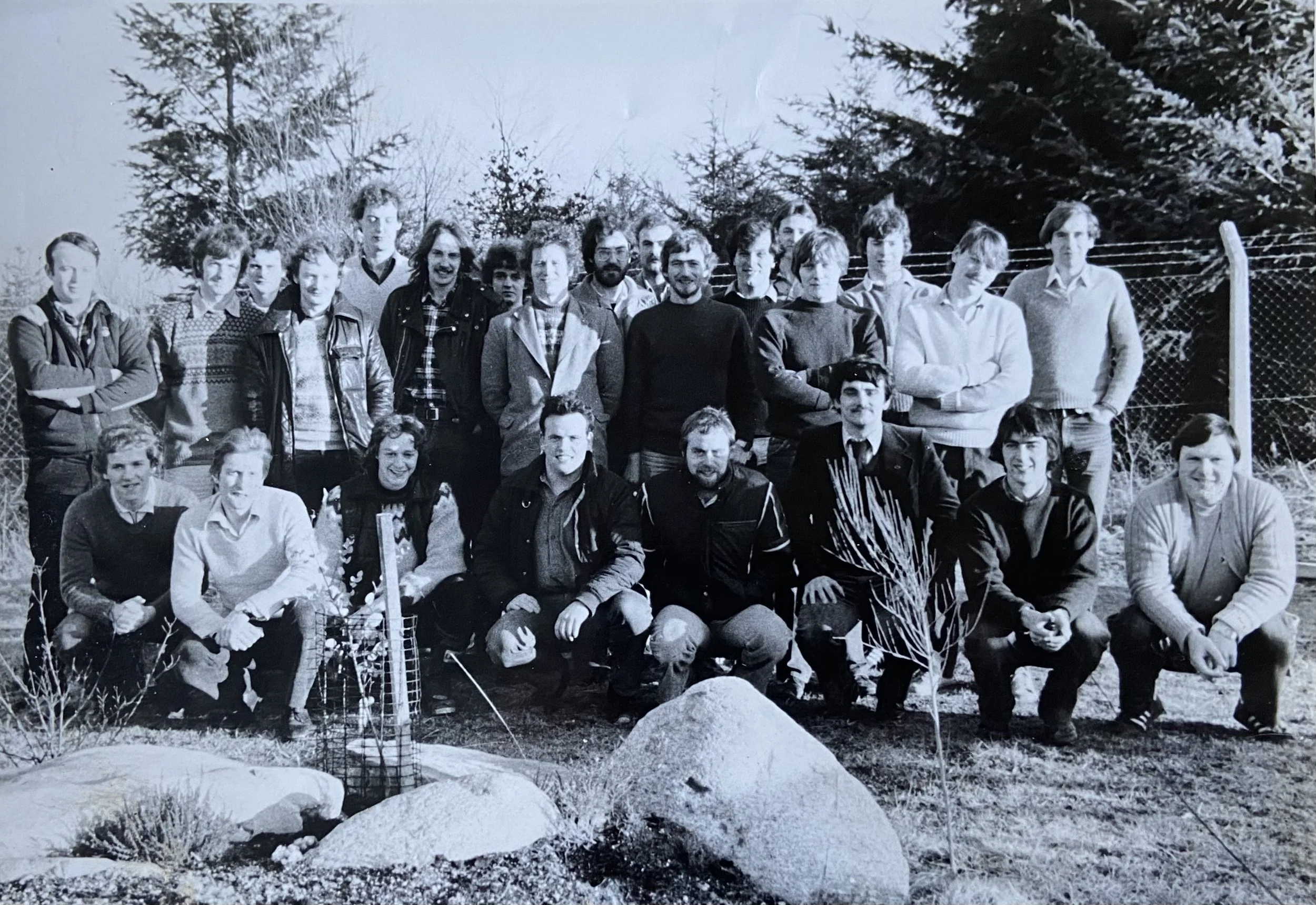
Students of the 1981 intake at the Scottish School of Forestry; Kevin is in the middle at the back, with a beard.
Born in Orkney, Kevin moved to the Glenkens at just one year old, when his father got a job at the power station in Glenlee. He attended both primary and secondary school in Dalry and went on Kircudbright Academy to do his ‘O’ Levels. “I didn’t much like school. In fact I wasn’t a good student and I had no ideas about careers then.”
Kevin’s introduction to forestry was as a teenager; to escape from hated weeding duties in his mother’s garden in Glenlee, he took a holiday job as a labourer for head forester Bob Watson on Fred Olsen’s estate. “It was very demanding physical work, growing and planting tree seedlings and weeding bracken with a ‘heuk’ (sickle). Not many could stick it. Some of my school classmates only lasted a day but I liked it and it paid well; £5, 9 shillings and 6 pence a week. And it gave me a taste for work as a forester as I loved being outdoors and close to nature. But then I parted company with it for a while.”
“When I left school, I never thought of forestry as a career. I went on to do a variety of other jobs, including a stint as a trainee clerk in the bank in Dalry - that definitely wasn’t for me - and a brick maker in Staffordshire. However, after a few years I realised I had a hankering for it; it gave me a purpose, producing something useful. So I came back to Galloway to work with the Forestry Commission at Bennan Forest. In those days there was a labour shortage and they needed people; I asked about a job at the end of one week and started on the Monday of the following week! After three days, they trained me in using a chainsaw and within a month I was doing piecework felling trees, paid by the volume of timber I felled. That meant I had to work fast to earn a living. But I stuck with it and moved to Inverness with the Forestry Commission, where I did a short City and Guilds course in forestry and then took time out to study on a longer three year course in 1981. I loved that; it covered all aspects of forestry and had a practical year in the middle. I finished up several years later as a member of the Institute of Chartered Foresters, taking exams to gain chartered forester status.”
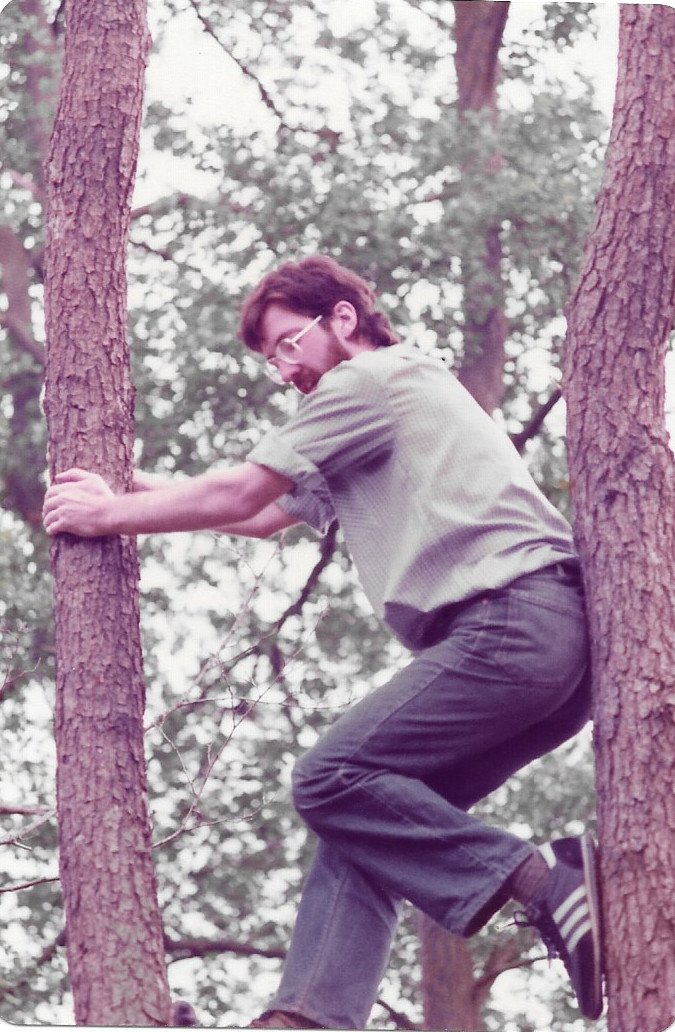
Kevin as a young man in 1983, ‘messing about’ in woodland.
“Working with the Forestry Commission meant you had to be willing to travel. After I finished the course, I moved south to a job in the New Forest in Hampshire. My poor wife Evelyn and our two girls got dragged all over the place during my career as I changed jobs! The New Forest was an interesting place to work as it involved more than just commercial forestry. Two thirds of the estate there is classed as open forest – heathland grazed by ponies and cattle under an old, feudal system of land rights that included pannage (letting pigs feed on the forest floor in the autumn), firewood collection and digging turf. There were tensions between the commercial forestry operations and the commoners who owned the livestock, which meant I attended monthly meetings between the Forestry Commission and Verderers (elected representatives from the grazers) to sort out problems. The Forestry Commission office was next to the medieval Verderers’ Court, in a building that felt like a mansion; even as a Junior Forester, I had a massive office with a huge antique desk! My work focused on recreation which included managing facilities for walking, horse riding and camping in the forest; these were a good source of income for the Commission at that time, generating more money than timber production. I enjoyed that role. The campsites were open and unfenced and part of the job was warning campers not to keep food in their tents so that the pigs didn’t break into them and to deal with situations where ponies had lain on a tent! Sometimes the ponies lay on tents where there were people inside them – I’ve no idea why – but there were no serious injuries. It was just a hazard you faced camping there.”
“My next post was back in Scotland as the manager of Kincardine Forest District, up in the north, east of Inverness. I loved this job! There was a lot of native pine woods to manage here, as a commercial crop and also for conservation as this type of forest is the preferred habitat for Capercaille. The pines were not planted but instead had grown naturally and so the goal was to keep them as natural as possible. Sometimes we thinned the forests and used natural regeneration rather than standard techniques of felling and replanting. Managing the forests in this situation required a longer term perspective and lots of planning to maintain a good crop rotation, ensuring that you have a ‘product’ – timber – over a prolonged period. We also had to liaise with the Balmoral estate as the forest had a share boundary with Crown land.”
“From Kincardine, I moved on to become District Forest Manager for Lochaber, based in Fort William. This was a huge area to cover and included the internationally important Loch Sunart oak woodlands which were managed for conservation. Some of the work here involved opening up or removing commercial forests to give space for natural regeneration to take its place and also getting rid of rhododendron manually, rather than using chemical forms of control. Another interesting project was using conservation grazing techniques to manage the ancient pine woodlands at Glengarry where a herd of Highland cattle was allowed to graze the land, to suppress heather growth and let the trees get above it. Working collaboratively with other organisations was also part of the job; we jointly managed one site with the Butterfly Conservation Society to maintain the right conditions for rare Chequered Skipper butterflies at a time when Lochaber was the only place in the UK where these butterflies were found. To do this, we had to control invasive bracken which shaded out a ground flora of violets, the preferred food source for Skipper larvae. Controlled grazing by Highland cattle was a very good way to achieve this naturally.”
“Whilst working here, I faced with some novel management challenges. One of the changes I oversaw was the opening up to the public of forests like the one at Loch Sunart that had previously been closed for conservation reasons. In the 1960’s the Forestry Commission was of the opinion that conservation and recreation should be kept separate. However pressure from the public changed forest policy to allow access for everyone. I was pleased about this; I’ve always seen forests as multipurpose, not just for commercial timber production, and an asset that everyone should be able to enjoy.”
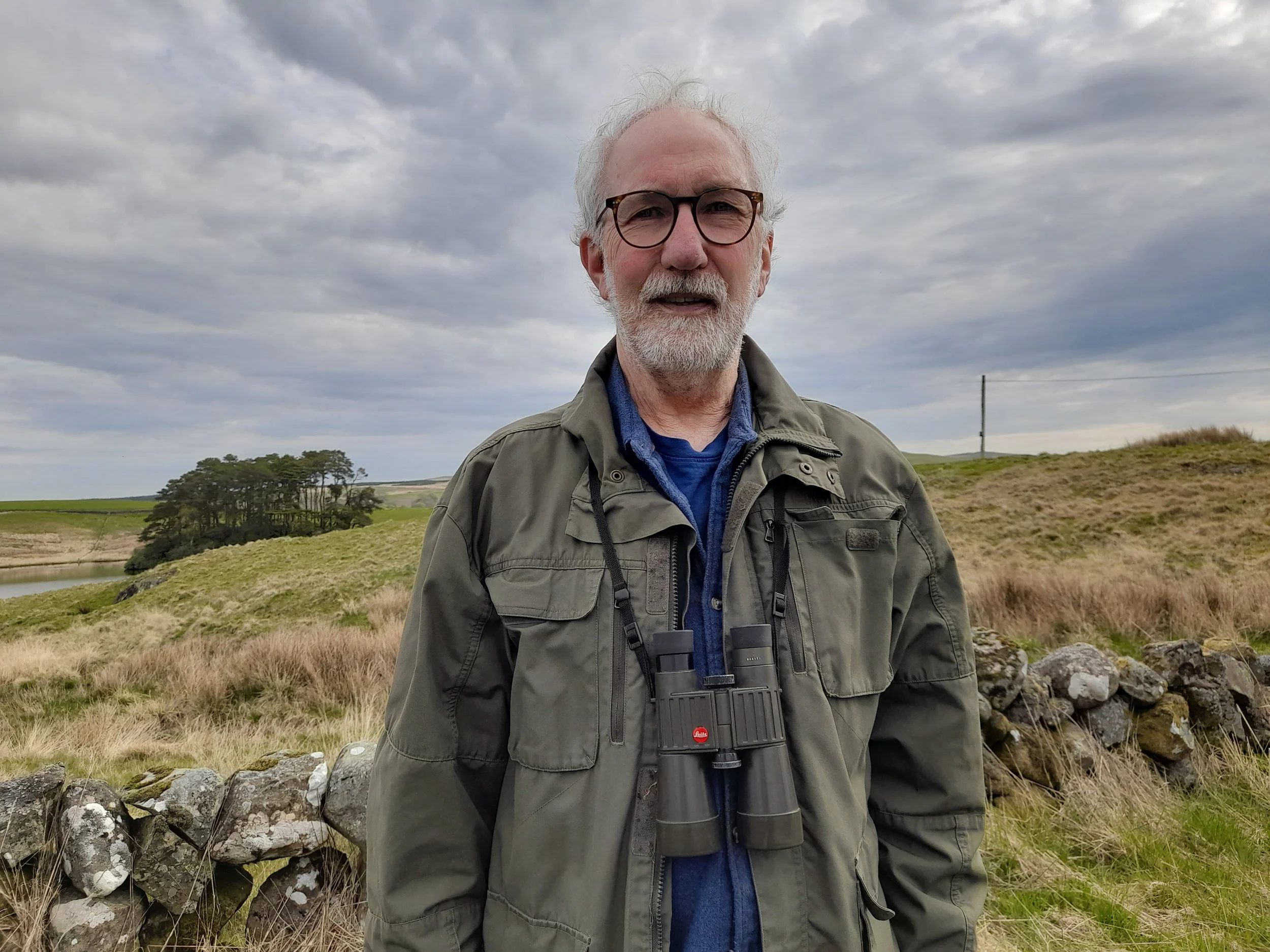
Kevin out bird watching near Moss Roddoch, Dalry.
“One of my proudest achievements was persuading the Chief Executive to buy some private woodlands in Lochaber at a time when expansion wasn’t popular. That was going against the grain but I felt these enhanced the whole estate of the Commission and those sites are still within public ownership today. One of them includes a Munro. I also argued in support of the findings from a public consultation in Fort William, proposing the creation of allotments on some of the forest estate. As a result, a piece of land was leased to Sunny Lochaber United Gardeners (SLUG) and the group successfully applied for funding to create allotments. It’s still going today; it was what people wanted.”
“Looking back on my working history, I’d happily recommend forestry as a career for a young person. There are a huge variety of jobs within the sector and many different specialisms to pursue, ranging from managing native woodlands, nursery work and commercial harvesting, to research, conservation and recreation.”
Returning to his much loved childhood home of Dalry with Evelyn (also a Glenkens native) on his retirement, Kevin still spends much of his time walking outdoors with a pair of binoculars round his neck. “One of my best childhood memories was going out to Back Bush (Back Hill of the Bush), near Clatteringshaws, with local forester Alex Marshall, catching and tagging deer calves. I still love going outside and keeping active so being an observer of wildlife is perfect for me. When I was in my first year at Dalry Secondary School, I told a careers advisor that I wanted to be a wildlife ranger and he responded that this was a stupid idea! But things have changed since then and being aware of nature and its importance is much more highly regarded. So I’m happy to fulfil that wish in my later years. And I’m very happy to be back in the Glenkens, where I grew up. Although the landscape here used to be more open when I was a boy, with pewits (lapwing) and whaups (curlew) all over, it’s still a beautiful place to live. ”