
Jim Ramsay: Hill farming in the Glenkens
Land and living in the Glenkens
Does farming matter? This was a question posed by Minette Batters (former Chief Executive of the National Farmers Union) in her introduction to the Farming Profitability Review, published in 2025. “Whether farming matters and how it is valued is fundamental to the future of farming across the UK” she stated. In a series of articles, the Gazette wants to show how working the land matters to all of us living here. Through interviews with local farmers and landowners, we want to explore some of the issues facing the people who work in agriculture and forestry in the Glenkens. These are the people who shape the landscape so many of us love. They have a big influence on our lives as the producers of the food and materials we need to survive and thrive. We want to give them a voice and learn from them directly what matters to them, what they love about their work and how they deal with some of the problems they face.
Situated on higher land close to Lochinvar reservoir, Milnmark Farm has been owned by the Ramsay family for over 50 years. Working the land there, Glenkens resident Jim Ramsay makes a living from livestock farming.
I’m the second generation here; my father moved from a dairy farm in Wigtownshire moving first to Lagheadfarm near Gatehouse, where we lived for three years, before making the move to Milnmark. While my father was keen on dairy farming, beef cattle and blackface sheep, in particular, were always where his heart lay. I now manage the farm in partnership with my two brothers and hope that the next generation, my son and his cousins, who are all keen on farming, will carry on. My son Andrew works on the farm although he’s off shearing at the moment.
Farming in the uplands is harder than on the more productive land in the lowlands; the soils are thinner and we get more rain. Tending to livestock is our main job throughout the year. We keep 800 blackface ewes and 100 Angus beef cattle. We have around 200 acres of in-bye land and manage to produce almost all our own silage for the cows. We raise hardy breeds that can stay out on the hill all year round, but they require feeding in the winter months. The calves are sold in the autumn to avoid having to overwinter them; they go to other farmers with better ground.
We lamb the ewes outside, usually starting around 7 April. After lambing, my time is taken up herding the ewes and their lambs, along with all the usual tasks that need to be attended to at that time of year. Ewes and lambs need wormed and the lambs all need to be vaccinated. This busy spell culminates with the shearing of the ewes. After shearing, this is a time of year when the pressure eases slightly before silage-making starts later in the summer. Come September it's time to start preparing sale animals for the breeding sales in October.
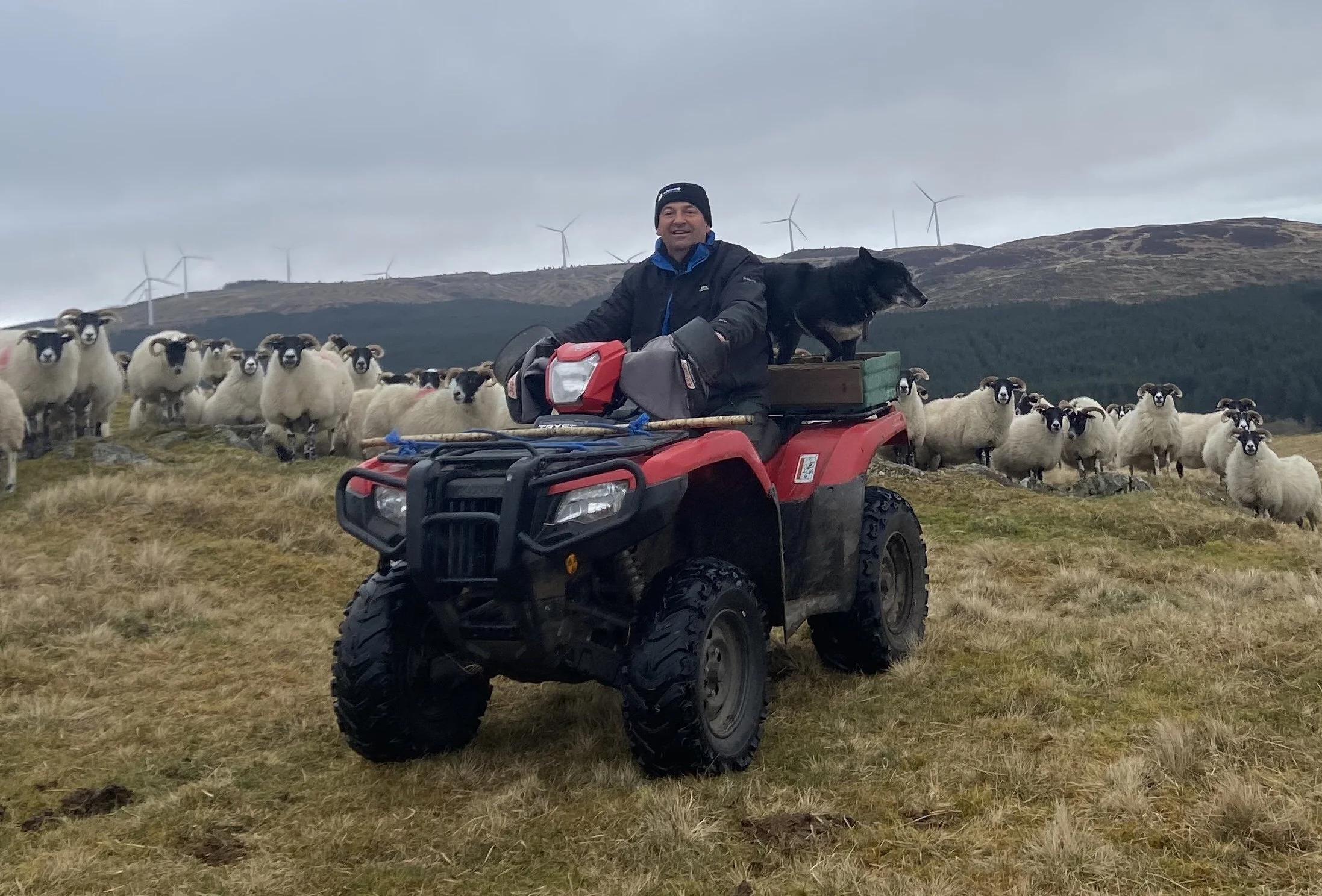
Jim Ramsay
We take stock to the local livestock sales at Castle Douglas, Newton Stewart and Ayr. In recent years we have ventured further afield to Lanark, Stirling and Dalmally. For livestock farms like ours, this is the ‘harvest time’ and most of our income is made during this period. The sales are also a great social occasion and a chance to catch up with other farmers; they’re good friends, even if you only see them once or twice a year.
Taking animals to the agricultural shows is also another opportunity to meet up and show off your best livestock. We visit most of the local shows; Glenkens, Carsphairn and Dumfries. It’s always nice to see good stock other farmers have brought out and seeing them do well at the shows. At the end of the day, we’re all in the same boat.
I enjoy working with livestock and get satisfaction from raising good quality, healthy animals, and it’s always nice if you can get a good price for them at market as well. I also like the challenge posed by breeding; it takes a bit of time and effort to work out what breeding combinations might be successful and deliver a prize beast, and sometimes it works... but sometimes it doesn’t. There are always challenges. We have good and bad years with the weather, but BSE and COVID posed some really big challenges. One particular local issue is the increase in afforestation in this area that has a big impact on the value of the land.
Most hill farms are viable, even if not that profitable, but forestry has inflated land prices locally and made it difficult for farmers to buy land, especially new entrants to farming. Tenancies for young people have have also become few and far between. Even in the instance when a farmer is retiring for example, it’s difficult to avoid selling to the forestry companies ‘loaded’ with city investors' cash and offering such high prices. Unfortunately, the Scottish Government’s targets for commercial forestry mean that South West Scotland is seen as the golden triangle for planting, which is having a real impact, not only on farming in the uplands, but also on ground nesting bird populations which the RSPB regard as being of international conservation importance.
Once common birds such as the curlew and skylark are losing the land they rely on. Just like our rural populations, our native wildlife, that has evolved alongside upland farming for centuries, is quietly disappearing from the landscape. In my lifetime, I’ve seen a massive change in the landscape, mostly due to commercial forestry The argument is that it provides jobs and helps the local economy, but I don’t support that view. In fact, in what I believe has been the only study done in Scotland to compare employment in forestry with the hill farming it is replacing – carried out around Eskdalemuir – the conclusion was reached that, once all the peaks and troughs of the forestry cycle were ‘smoothed out’ forestry actually provided 17% less jobs than hill farming. It seems quite mad to me, that in order to create five forestry jobs for far-off based forestry contractors, lorry drivers and foreign tree planters, six local shepherds and stockmen have to be displaced from the land.
I also have no truck with the idea that planting coniferous trees in upland areas sequesters carbon in the trees and the soil. In fact the opposite is true, if you look at it from a longerterm perspective and take account of carbon loss from soils when they are disturbed for tree planting. In addition, there are substantial global warming impacts from the albedo change when the land cover changes from upland grassland to dark conifer forest. These forests absorb far more solar energy which in turn causes additional warming in the atmosphere.
All that, then roughly a quarter of the ‘sequestered’ carbon is burned as biomass, pumping even more CO2 into the atmosphere. So the idea of ‘carbon credits’ being achieved from tree-planting is rubbish, in my opinion. I’ve done lots of research on this and have tried to raise the issue both locally and nationally, but the notion of growing trees to meet climate targets is such an easy answer for politicians. They, and indeed the press, are simply not interested in the actual science on this matter.
In the meantime, I just keep farming with my family. Reflecting on all changes on the land, not just in the last 50 years, but going right back to early civilisations, I think that those of us farming now are not so different from those who did so away back in the Bronze Age; we persevere and we evolve with the land. What drives most farmers on is the ultimate desire to pass the land on to the younger generation and hopefully ‘see’ our way of life carry on for many more generations to come.
You can find Jim’s assessment of carbon offsetting and forestry in the Land Use Special in Issue 130, in the Glenkens Gazette archive here.